BAREFOOT CHAMPION: SHAMBEL ABEBE BIKILA
BEYOND HIS INDIVIDUAL FEATS, BIKILA’S TRIUMPH AT THE 1960 ROME OLYMPICS HELD PROFOUND SIGNIFICANCE ON A GLOBAL SCALE
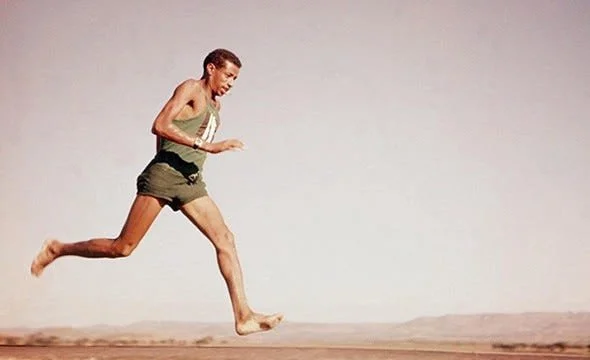
The barefoot champion: Shambel Abebe Bikila
Shambel Adebe Bikila, widely known as the barefoot champion, remains one of Olympic history’s most enduring icons. Born in 1932 in a rural part of Ethiopia, Bikila rose from a military-run sporting programme to become the first Sub-Saharan African to win Olympic gold, and the first to claim marathon glory without shoes.
Bikila’s ascent began in the Ethiopian army, where his remarkable endurance caught the eye of coaches and scouts. Trained as a long-distance runner, he developed a disciplined, efficient style that emphasized cadence and a relentless, even pace over long distances. His path led him to Rome in 1960, where fate and practicality intersected on a scorching track.
In Rome, Bikila ran the 42.195-kilometer marathon barefoot after his footwear wore out and he preferred feeling the ground beneath him. He crossed the finish line first in a world-record 2 hours, 15 minutes, and 16.2 seconds, becoming Africa’s first Olympic gold medalist and the first from Sub-Saharan Africa to reach the pinnacle of the sport. The victory sparked jubilant scenes across Ethiopia and reverberated across the continent, symbolising independence, dignity, and competitiveness on the global stage.
Four years later in Tokyo, Bikila returned to the marathon course, again barefoot, and secured a second consecutive Olympic title with a time of 2 hours, 12 minutes, and 11.2 seconds. The back-to-back triumphs cemented his status as a legend of distance running and broadened perceptions of what athletes from Africa could achieve under the world’s most demanding conditions.
Bikila’s approach to racing, conserving energy in the early stages, then unleashing a powerful rhythm in the second half, reflected a philosophy of endurance and mental toughness. His training emphasised efficient mechanics, a strong aerobic base, and a close connection to terrain. Off the track, he carried the poise of a national symbol, bearing the expectations of a continent eager to prove itself on the world stage.
Quotations from contemporary accounts and athletes
Contemporary report, Rome 1960, sport columnist: "Bikila ran as if the ground itself was an ally, and the heat of Rome merely a backdrop to an Ethiopian who could outlast any man in the field."
Photographer covering the finish, Rome: "When Bikila crossed the line barefoot, the crowd erupted; it was not just a win but a declaration that Africa could own the marathon."
Ethiopian coach at the time: "We taught him to value endurance over equipment. His feet became the instrument, his heart the engine."
Fellow Ethiopian runner and contemporary rival: "Shambel showed us that faith and training could defy circumstance; his feet told a story the track could not forget."
Tokyo 1964 assistant coach: "He treated each race as a test of spirit. Even with pressure from home and a world watching, he stayed calm, performed, then gave the sport back to Ethiopia with honor."
Contemporary sports journalist, Tokyo 1964: "Two golds barefoot in two Games is not merely a record; it’s a legend etched into the track, a beacon for every young runner from a rural village."
Public reaction
Ethiopian public and government officials lauded Bikila as a national hero, and his victories fed a growing sense of pan-African pride across the continent. African leaders and athletes cited his triumphs as evidence that talent from African soil could compete with and surpass the best in the world, wearing nothing but determination.